The Making of a First-Generation Finance Professional
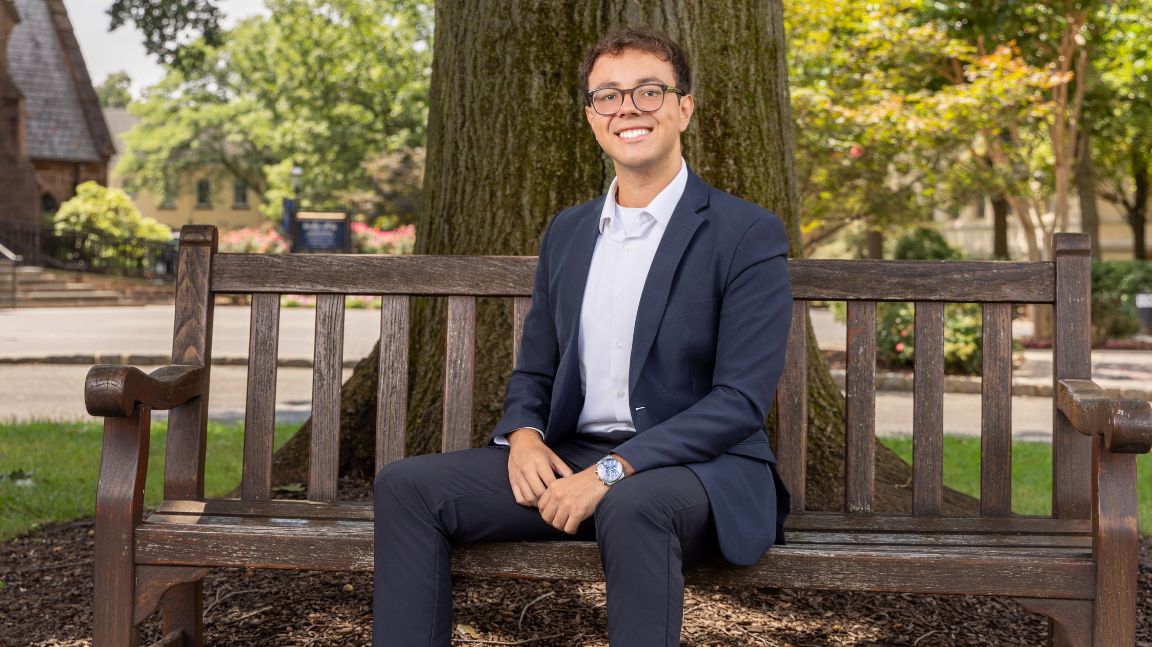
Support From the Joseph A. Unanue Latino Institute Helped Lucas Brasil Become a Leader
Lucas Brasil didn’t expect to find himself at Seton Hall. In the fall of 2021, early
in his senior year at Long Branch High School, he figured he’d end up going to his
local community college after graduation. That was a typical trajectory, according
to Brasil, for first-generation Latino kids in Long Branch, an economically stratified
city near the top of the Jersey Shore.
“First generation students — we have a glass ceiling,” Brasil says. “My goal was to
break that glass ceiling.”
Four years later, Brasil is thriving as a senior at Seton Hall’s Stillman School of
Business, where he is completing a Bachelor of Business Administration in finance
and accounting. While an academic scholarship made Brasil’s Seton Hall education possible,
he says he wouldn’t have been able to truly maximize that education without additional
support from the Joseph A. Unanue Latino Institute.
Thanks to a generous gift from Joseph and Carmen Ana Unanue, the Unanue Institute immerses students like Lucas Brasil in Latino heritage, while shaping the next generation of servant leaders in an ever-changing global society.
Created in 2005, thanks to a gift from Joseph and Carmen Ana Unanue, the Institute’s
mission is to help students “fulfill their potential as worldly servant leaders through
programming designed to immerse students in Latino heritage through education, academic
scholarship, mentorship, professional development, and critical thinking.”
Brasil received a Joseph and Carmen Ana Unanue Student Scholarship as well as the
Institute’s Lider Award, both of which require applicants to demonstrate an appreciation
of Latino/Hispanic culture, history, and community life. These additional funds covered
Brasil’s cost of books and offset annual tuition increases. They also enabled him
to maintain an 18-credit course load as opposed to the standard 15 credits.
“Without that support,” Brasil says, “I’d be thinking, how am I going to find a way
to pay for these books? Or, maybe I have to drop three credits. I wouldn’t be performing
at 100 percent, because I’d have this worry in the back of my mind. I’m grateful for
these scholarships because they help me focus on what I need to be focusing on.”
Brasil became interested in finance during his freshman year at Seton Hall, partly
based on his firsthand experience with financial uncertainty growing up. Brasil’s
parents, a tile installer and a house cleaner, had immigrated from Brazil. They worked
hard so that Lucas, their only child, could concentrate on school and sports without
having to get a job of his own during high school. He made sure not to squander their
sacrifice, taking advanced classes and keeping his grades up. Still, he wasn’t planning
very far beyond pursuing an associate’s degree.
Encouraged by his pre-calculus teacher to aim higher, Brasil applied to several universities
and chose Seton Hall after receiving a scholarship, becoming the first in his family
to attend college.
At Seton Hall, Brasil’s additional Unanue funding gave him the bandwidth and financial
security to pursue meaningful extracurricular activities that benefit the university
and its students. He served as marketing director at the Unanue Institute, using social
media and email campaigns to raise awareness about the Institute, and to promote events,
such as a talk with the political strategist Luis A. Miranda Jr. (father of Lin-Manuel
Miranda). He also joined the Association of Latino Professionals For America (ALPFA),
rising up to the role of chapter president in 2024.
Brasil’s work at ALPFA became the basis of his junior-year project at Seton Hall’s
Buccino Leadership Institute, a prestigious four-year certificate program in leadership
development. For the project, Brasil utilized a community-service stipend from his
Lider Award to organize career development events through ALPFA. These included on-campus
recruiting sessions for students, visits to the offices of major financial firms,
and a day-long symposium attended by more than 500 students and professionals. He
also spearheaded charity fundraisers, a food pantry, and a toy drive. “It really brought
into perspective the impact we can make if we put our best foot forward,” he says.

First generation students—we have a glass ceiling. My goal was to break that class
ceiling.”
These experiences, made possible through his Unanue scholarships, strengthened Brasil’s
connection to his first-generation Latino heritage. “It’s something I think about
every single day,” he says. “Being first-generation means being disciplined, being
able to adapt to any situation. The more we learn, and the more we understand how
our parents sacrificed for us to have opportunities, the more it enables us to push
harder for what we set out to achieve.”
After graduating from Seton Hall, Brasil plans to secure a full-time job with a financial
firm, building on the experience he gained through an internship with EY-Parthenon,
a division of Ernst & Young, where he spent the summer of 2025 working as a strategy
and transactions analyst. After gaining some real-world experience, he intends to
pursue an MBA in another two or three years.
Brasil is confident that the values he cultivated during his four years at Seton Hall,
especially those rooted in servant leadership, will shape his career. Above all, he
looks forward to mentoring aspiring financial professionals.
“Going into finance, I want to be able to provide value and information that will
help others coming up in the field,” he says. “Down the line, I’d really like to be
a helping hand to those who have questions or need advice. It’s important not to lose
sight of that.”