An Award-Winning Scientific Discovery
Chemistry funding from donors like Thomas and Sylvia Tencza is enabling breakthroughs in Seton Hall’s research labs.
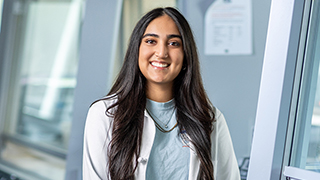
Sanskruti Brahmbhatt, '25, a biology major at Seton Hall.
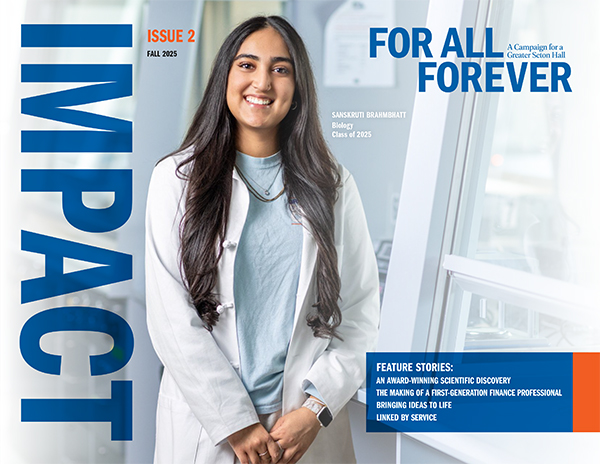
Sanskruti Brahmbhatt, '25, a biology major, was immersed in her undergraduate research on phthalocyanines — that's THAL-oh-SIGH-uh-neens — when a lightbulb moment occurred. Phthalocyanines are compounds that can be used as light-activated drugs to treat diseases such as cancer. The team at Professor Sergiu Gorun's Seton Hall University research lab, which Brahmbhatt joined freshman year, had been trying without success to locate a particular type of isomer within the compound they were studying.
Working under the guidance of Assistant Professor Marius Pelmus, Brahmbhatt had an idea: What if she dug deeper into the lab's discarded samples? "I was curious," she says. "And what I ended up realizing was that the band of molecules we had been tossing all these years had that isomer in it."
Brahmbhatt ended up writing an undergraduate thesis on her breakthrough, which she also presented at the Independent Colleges and Universities of New Jersey's 2025 Undergraduate Research Symposium and Seton Hall's 2025 Petersheim Academic Exposition. She earned second-place honors at both.
"Research is this very beautiful sweet spot between the science we know and the science we don't," says Brahmbhatt. "That's why I like it so much. With science, there's a security in knowing how to solve a problem, but there's also lots of space for discovery."
The late Thomas M.S. ’64/Ph.D ’66 and Sylvia Tencza donated more than $10 million that is being used to endow a professor and support research in Seton Hall’s chemistry department. Students like Sanskruti Brahmbhatt, whose work relies on expensive lab equipment and research technology, have thrived as a result of their generosity.
At Seton Hall, discoveries like Brahmbhatt's wouldn’t be possible without support from donors like Thomas and Sylvia Tencza. Thomas, a Bristol-Myers Squibb executive who helped create medications, including Excedrin and Bufferin, died in 2012 at the age of 80. Sylvia, a Fairleigh Dickinson alumna and executive assistant at a medical technology firm, died in 2024 at the age of 87. They left behind more than $10 million for Seton Hall's chemistry department, where Thomas earned his doctorate nearly six decades ago. "He always wanted to do something that would make a difference in the chemistry department," Sylvia said when their gift was first announced in 2016.
The Tenczas' funding is making a big difference for students such as Brahmbhatt, who continues to work in Gorun's research lab post-graduation. "One small test tube used for analyzing samples costs $500," she says. "All the machines I've worked with cost hundreds of thousands, if not millions, of dollars. The equipment in our lab exists because Seton Hall has gotten funding from the chemistry department to buy beakers, to buy flasks, to buy different solvents and reagents. The funding we receive is what allows us to make discoveries at the high level we're currently able to."

The funding we receive is what allows us to make discoveries at the high level we’re currently able to."
Brahmbhatt fell in love with science as an elementary-school student in Hightstown, New Jersey. During eighth grade, Brahmbhatt's grandfather was diagnosed with colon cancer. She accompanied him to doctor and hospital visits, translating complex medical information from English to Gujarati, his native Indian language. She was there for his chemo infusions, radiation treatments, and kidney dialysis. In the end, Brahmbhatt's grandfather died less than two years post-diagnosis. "By that point I knew I wanted to go into healthcare," she says.
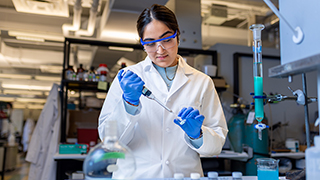
Brahmbhatt performing research in a science lab at Seton Hall.
After graduating high school at the Health Science Academy of Mercer County Technical Schools, Brahmbhatt applied to a number of top colleges, including Seton Hall, which a close friend was planning to attend. "I came for a tour," she recalls, "and when I saw a mural in the atrium of McNulty Hall representing the interplay between faith and science, that was the moment I knew this was where I wanted to go." Brahmbhatt says she received an "incredible scholarship" as well as funding through the Dean's Undergraduate Research Grant. "Throughout my time here, I've received some sort of grant or scholarship from the school to continue doing research, which is life changing because it allows me to be here and to stay focused on my work 100 percent."
Raised in the Hindu faith, Brahmbhatt felt aligned with Seton Hall's Catholic mission. "The thing I love about the University is that they don't necessarily push Catholicism, but they do push the Catholic value of service," she says. "Leadership by example is really emphasized here. I don't think many other universities focus on the morals and ethics of what it means to be a human being the way Seton Hall does. And one of the other things I really appreciate about Seton Hall is the requirement of volunteer hours."
Brahmbhatt's volunteerism included organizing blood drives as president of Seton Hall's branch of the University Blood Initiative. She also served as president of Alpha Kappa Psi, a co-ed business fraternity, and fundraised for students in need of emergency scholarships through Seton Hall's Student Alumni Association. "I really learned about the impact that alumni have as a whole," she says.
Over the coming academic year, Brahmbhatt plans to continue her research at Seton Hall, assuming she can secure additional grant funding. She'll also be working in the emergency room of Jersey Shore University Medical Center as a medical scribe, a person who logs the symptoms of incoming patients, briefs the attending doctor, and takes notes during the doctor's subsequent examination. And, of course, she'll be applying to medical schools for admission in fall 2026.
Inspired by her grandfather's cancer journey, Brahmbhatt ultimately wants to work in research oncology. "Gastrointestinal cancer is on the rise," she notes. "I'm interested in figuring out how the outside world can affect our internal body. But also, if you have cancer, how can we slow it down?"
Her ultimate goal is to develop new treatments. "I would love to work at St. Jude's," she says. "The way they treat children at no cost to their family — that is my dream job."
Based on the promise Brahmbhatt has shown at Seton Hall, her future looks bright. Thomas and Sylvia Tencza, meanwhile, would be proud to see just how far their generous gift has gone.